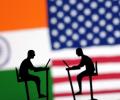
India and the US have reported positive progress in recent trade talks in Washington, agreeing to maintain engagement to finalise a bilateral trade agreement, which now requires recalibration following new US tariffs.

The US Fed's interest rate decision will be the major factor dictating trends in the domestic equity market this week, with global movements and foreign investor activity also influencing sentiment, according to analysts. Stock markets ended the last week on a subdued note, with benchmark indices Sensex and Nifty closing flat.

The Netherlands cricket team is excited to play against India in their final T20 World Cup league fixture at the world's largest cricket stadium in Ahmedabad.

The benchmark BSE Sensex's trailing 12-month price-to-earnings (P/E) multiple has declined to 20.2x, its lowest since May 2020, driven by a record $42 billion FPI selloff since September 2024 and concerns over corporate earnings and economic growth.

Indian shipyards Mazagon Dock Shipbuilders Limited (MDL), Garden Reach Shipbuilders & Engineers Limited (GRSEL), and Cochin Shipyard Limited (CSL) are set for substantial growth, driven by a significant pipeline of Indian Navy orders and diversification into commercial and export markets. The Navy's share in defence spending is approximately 21 per cent, ensuring robust order visibility for these domestic players.

Despite recent share price dips, Bharti Airtel is strategically positioned for growth, driven by investments in data centres via Nxtra, a potential tariff hike, and strong performance in Africa, alongside efforts to deleverage and expand its subscriber base in underpenetrated rural markets.

In the present hyper-connected world, there are many domestic and global factors that affect financial markets. Of them, the most powerful and often least predictable are geopolitical events, which often boil down to one diplomatic headline.

A strong third-quarter (October-December/Q3) performance for 2025-26 (FY26) has helped the stock of India's largest listed pharmaceutical (pharma) company, Sun Pharmaceutical Industries, gain about 7 per cent since the start of February.

IndiGo, Air India, and SpiceJet are opposing the government's directive to offer 60% of seats for free selection, arguing it will lead to increased airfares to compensate for lost revenue.

Even if there is an early agreement on a cessation of hostilities in West Asia, the price shock will not go away easily, points out A K Bhattacharya.

India's aviation sector is facing fresh turbulence, with rising fuel costs, the Ministry of Civil Aviation's free-seat directive, and geopolitical disruptions in West Asia clouding near-term earnings visibility.

There are hopes of a turnaround in overall corporate earnings after six quarters of single digit growth.

Foreign investors fled Indian equities in 2025 at a scale never seen before, pulling out a record Rs 1.6 lakh crore (USD 18 billion) as volatile currency movements, global trade tensions, especially potential US tariffs, and stretched valuations eroded risk appetite, though flows are expected to turn sustainably positive in 2026.

'Decisions on talent and rewards have shifted as employees and companies are operating in a buyer's market across most skill categories.'
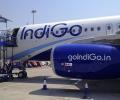
InterGlobe Aviation (IndiGo) is experiencing significant financial pressure, with its stock falling 18 per cent since the start of the Iran war, due to rising Brent crude prices, a weakening rupee, and disruptions to its West Asia and European flight networks caused by geopolitical tensions.
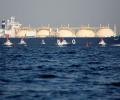
Analysts predict India will face oil price volatility and macroeconomic effects due to the escalating Iran crisis, though the country's oil supply chain is not yet structurally insecure.
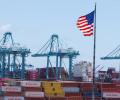
Indian exports to the US will face a 10% tariff, down from 25%, for 150 days following a US Supreme Court ruling. However, uncertainty persists due to potential further tariff hikes and long-term implications.
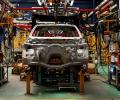
Passenger vehicle dispatches from companies to dealers in the domestic market declined marginally year-on-year in July, hit by muted demand, industry body SIAM said on Thursday. Passenger vehicle dispatches declined to 340,772 units in July, compared to 341,510 units in the same month last year.

India's $280-billion IT industry heads into 2026, balancing visa-related headwinds and global trade uncertainty against its biggest-ever push into artificial intelligence and the rapid expansion of global capability centres (GCCs). Heightened scrutiny of the US H-1B visa programme - including a proposed $100,000 fee for new visas and concerns over a potential 25 per cent outsourcing tax - has complicated cross-border delivery for Indian firms, even as companies accelerate efforts to reduce reliance on onsite staffing.

Foreign portfolio investors (FPIs) withdrew a substantial amount from Indian equities in the first half of March, driven by geopolitical tensions, rupee depreciation, and concerns about crude oil prices.

Only about a quarter of institutions show any meaningful alignment between academic curricula and industry requirements.

Indian capital markets are witnessing a boom in IPO activity in 2025, with the current calendar year being expected to be the largest IPO year in India's history, according to India heads of foreign banks on Wednesday.

Every investor loves a bull market - that feeling of watching portfolios rise and headlines being filled with record highs is gratifying. Yet, wealth creation in the stock market is not just a matter of market rallies. Some of the most successful investors make their fortunes in periods of slow or even negative market momentum. The secret is mindset, strategy, and disciplined investing, not chasing short-term rallies.

Under the TMC, Bengal has seen expansion of welfare, but not big-ticket private investment.

Retail investors are moving away from a buy-and-hold approach and towards more informed short-term positioning, recent investment patterns show.

Petrol diesel price today March 20, 2026: IOCL & HPCL hike premium petrol (XP95, Speed, Power) by 2/litre and industrial diesel by 22/litre. Regular petrol in Delhi 94.77, diesel 87.67 unchanged. Full city-wise rates inside.

Bullish on the Indian market, Japanese consumer durables company Panasonic said on Thursday it was ready to increase investments in the country and line up new products.
Petrol diesel price today March 20, 2026: IOCL & HPCL hike premium petrol (XP95, Speed, Power) by 2/litre and industrial diesel by 22/litre. Regular petrol in Delhi 94.77, diesel 87.67 unchanged. Full city-wise rates inside.

India has managed high government debt-to-GDP, a slowing domestic revenue engine, lower household savings and a more hostile geopolitical environment separately in the past. But together, they threaten to undo the growth narrative on which today's optimism rests, warns Debashis Basu.

While investors would focus on the results and guidance for the third quarter of financial year 2025-26 (Q3FY26) in the normal course of business, the US-Israeli attack on Iran and the latter's retaliation at Gulf allies of the US has forced them to weigh the consequences of the event.

'The next phase of India's IPO cycle will be defined by quality, pricing discipline and investor selectivity.'

Equity benchmark indices Sensex and Nifty experienced a significant decline, primarily driven by a selloff in IT stocks due to concerns about AI disruption and renewed worries over global trade.

Tata Steel is strategically positioned for growth, leveraging India's robust steel demand, significant cost transformation programmes, and favourable protectionist policies in the EU and UK. The company is expanding its India capacity and optimising operations in its European units to enhance profitability and reduce debt.

Nayara Energy, a private fuel retailer in India, has increased petrol and diesel prices following a surge in global oil prices due to Middle East tensions. This move contrasts with state-owned retailers who continue to freeze prices.

We cannot simply have a 60-65 per cent import dependency in LPG, the bulk of which comes from just one volatile region -- West Asia, points out R Jagannathan.

India's new manufacturing project announcements more than halved in the fourth quarter of FY26, falling 60 per cent sequentially and 78 per cent year-on-year to approximately 1.7 trillion, driven by global uncertainties, geopolitical conflicts in West Asia, and existing unutilised manufacturing capacity.

This is the second-worst performance by the pack during this period over the last five years since CY20.

The India-US trade deal has offered a much-needed breather for the Indian information technology (IT) industry, which has been grappling with global macroeconomic uncertainty and subdued client spending over the past few years.
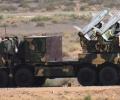
India's defence sector is on the cusp of a 'super cycle' of growth, driven by escalating geopolitical conflicts and a strong policy push towards indigenous manufacturing, with major players like BEL, HAL, and BDL poised for significant order inflows and technological advancements.

Among Sensex firms, Bajaj Finance, ICICI Bank, Hindustan Unilever, Bajaj Finserv, HCL Tech and HDFC Bank were the major gainers. However, Maruti, Eternal, UltraTech Cement and State Bank of India were among the laggards.
